Seawall replacement and new seawalls around Daytona Beach
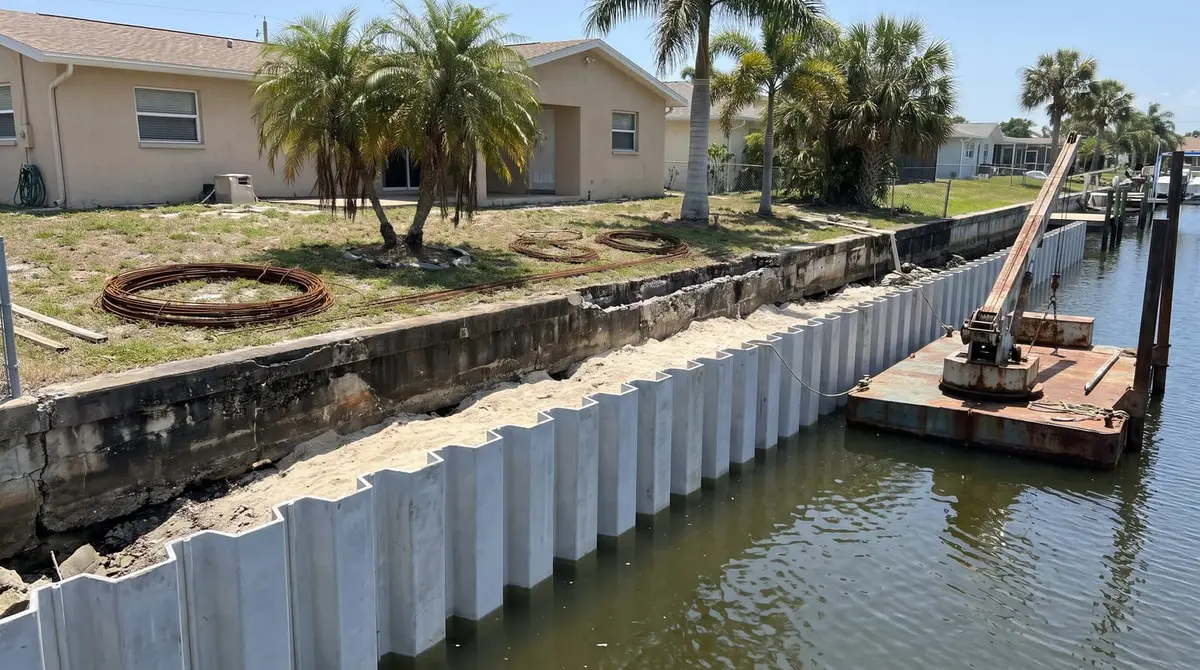
A seawall is worth replacing when the repairs would cost about half as much as a new wall, or when the panels themselves are cracked through at the waterline. A new concrete wall runs roughly $200 to $800 a foot in Angi's 2026 figures, and the permit path is easier when the new wall goes where the old one stood.
Call (386) 333-6570Rather not call? Send the detailsCalls are answered weekdays, 9 to 6. After hours, leave your name, address and what's going on, and you'll get a call back first thing the next business day.
When should a seawall be replaced instead of repaired?
A wall is usually past repair when you see:
- Panels cracked at the waterline: Cracks with rust on the water side mean the steel inside the panels has corroded; the owner's manual calls the fix new panels, cap, tiebacks and anchor.
- The whole wall leaning: When the bottom has washed out along a long stretch, the panels tip out and the cap rotates.
- Repairs that keep coming back: Holes refilled every season, joints resealed again and again.
- Repair quotes near half of new: Angi's rule of thumb: at about 50 percent of the cost of a new wall, replacing is often the better buy.
A wall built more than 30 years ago is also worth a hard look. After Ian and Nicole, Florida's environmental agency found that most of the walls destroyed in Daytona Beach and Daytona Beach Shores were that old, with thin, short panels and corroded steel.
Can a new seawall go in front of the old one?
Often, yes. Florida Statutes 403.813 exempts the restoration of a seawall at its old location, behind it, or within 18 inches waterward of it from a state environmental permit. Building just in front means the old panels can stay in place, so the yard isn't dug up to pull them out, and the gap between the walls is filled before a new cap ties everything together.
Past 18 inches, it's treated as a new wall. New vertical seawalls in estuaries and lagoons are not covered by the canal exemption, and walls on the ocean beach always need a state coastal permit. A local building permit is needed either way.
Concrete, vinyl or rock: which kind of wall?
| Type | Rough cost per foot | Typical lifespan | Notes |
|---|---|---|---|
| Concrete panels | $200–$800 | 30–50 years | The common wall on Florida canals: panels, a poured cap and tiebacks. |
| Vinyl sheet piling | $200–$600 | 50–60 years | Interlocking sheets with a concrete cap on top; no steel in the panels to rust. |
| Riprap (rock) | $70–$400 | Varies | Sloped rock that absorbs waves; often added at the foot of a wall rather than instead of one. |
Living shorelines, using oyster reef, mangroves and marsh grass to hold a bank, are another choice on some lots. Most small projects of that kind qualify for a state permit exemption, according to a fact sheet on Florida's environmental agency site, but they suit gentle banks rather than a deep boat basin.
How much does a new seawall cost?
Angi's 2026 national average for building a seawall is about $25,000, with most projects between $15,000 and $60,000. Per foot, a concrete wall is roughly $200 to $800 and vinyl $200 to $600. Permits add about $150 to $2,500, and a site survey, engineering or environmental review can add more on larger jobs.
Length drives the price more than anything: a 100-foot canal lot costs about twice a 50-foot one. Access matters next. If equipment can't reach the wall from the yard, the crew works from a barge, which adds cost. The cost guide compares jobs side by side.
What happens on a seawall replacement job?
- Look and measure: The contractor checks the old wall, the depth at the toe and how equipment can reach it.
- Permits: The local building permit, plus state paperwork if the wall isn't exempt.
- New panels: Panels are set on the old line or just in front of it and driven into the bottom.
- Anchors and fill: New tiebacks run to new anchors in the yard, and the space behind the wall is filled with filter fabric at the joints.
- Cap and finish: A concrete cap is poured along the top, and rock may go at the toe.
Common questions
Do I have to remove the old seawall?
Not always. Florida's exemption allows a rebuilt wall up to 18 inches in front of the old one, so many replacements leave the old panels in place behind the new ones.
Is vinyl better than concrete?
Vinyl has no steel to rust and HomeGuide gives it a longer life, 50 to 60 years against 30 to 50 for concrete. Concrete is the more common wall on Florida canals. The pro who calls back can say which suits your water and soil.
How long does a replacement take?
It depends on the length, access and permits. The permit and paperwork side often takes longer than the building.
Sources: Angi, How much does it cost to build a seawall? (Oct 2026) (source); Angi, How much does it cost to repair a seawall? (Oct 2026) (source); Angi, Riprap installation cost (Oct 2026) (source); HomeGuide, Seawall cost (lifespan by material) (source); City of Key Colony Beach, FL, Seawall owner's manual (2022) (source); Florida DEP, Hurricane Ian and Nicole post-storm beach conditions report (revised Aug 2023) (source); Florida Statutes 403.813, permits not required (2026) (source); Florida DEP, Coastal Construction Control Line program (source); Florida DEP, Permitting living shorelines in Florida (UF/IFAS and Florida Sea Grant) (source); Florida Statutes 553.79, building permits (2026) (source).
Last reviewed November 1, 2026.
Rather not call? Send the details
A local seawall and dock pro will call you back.