Seawall and dock permits in Daytona Beach and Volusia County
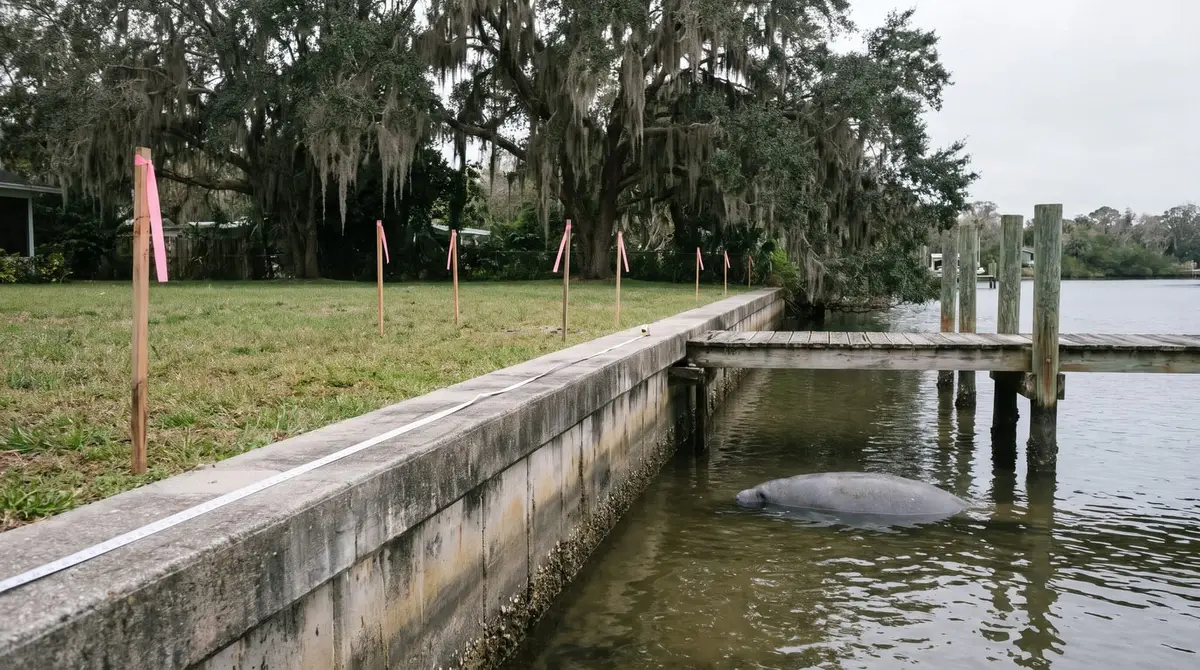
Almost every seawall, dock or lift job here needs a local building permit. What changes from job to job is the state side: many repairs and small docks are exempt from a state environmental permit, while new walls, larger docks and anything on the ocean beach are not. This guide sorts out which is which.
Call (386) 333-6570Rather not call? Send the detailsCalls are answered weekdays, 9 to 6. After hours, leave your name, address and what's going on, and you'll get a call back first thing the next business day.
Which jobs are exempt from a state permit?
Florida Statutes 403.813 lists work that doesn't need a state environmental permit. The ones that come up most on the Halifax and its canals:
- Seawall repair or rebuild: On the old line, behind it, or within 18 inches waterward of it.
- Dock repair or rebuild: Within 5 feet of the same spot and no larger than the old dock.
- A new private dock: Up to 1,000 square feet over the water, or 500 square feet in an Outstanding Florida Water, on pilings or floating, for recreation only.
- Docks and seawalls in man-made canals: Covered too, except new vertical seawalls in estuaries or lagoons outside an existing seawalled canal.
- Floating boat lifts: Exempt, and pile-supported lifts in an existing slip are exempt by rule if they add no platform or roof.
The statute is clear that an exemption doesn't remove county and city requirements. And for walls on the ocean beach, the state's Coastal Construction Control Line program still applies.
What are Outstanding Florida Waters around here?
Florida's water quality rule names Spruce Creek, including Strickland Bay and Turnbull Bay, and the Tomoka River up to I-4 as Outstanding Florida Waters in Volusia County, along with the Tomoka Marsh and Mosquito Lagoon aquatic preserves. Docks there are limited to 500 square feet for the state exemption, and Ormond Beach sets a lower dock limit inside the Tomoka Marsh preserve.
What does the county's manatee plan require?
Volusia County's manatee protection plan allows a single-family home one structure with one or two boat slips. A new structure pays a one-time mitigation fee of $412.45, and the county issues a Letter of Compliance. Work can start only once you have both the building permit and that letter. Inside a city, the city issues the building permit and the county handles the manatee review.
What about state-owned river bottom?
Where the bottom under a dock belongs to the state, the dock needs the state's permission as landowner. For one minimum-size private dock per lot, that's a letter of consent. Docks must also sit at least 25 feet inside your riparian lines, the lines that extend your side property lines out into the water; docks running along the shore need 10 feet, and narrow lots are handled case by case.
How big can a dock be in my city?
A January 2020 Volusia County memo compared the cities: 750 square feet in unincorporated Volusia, 500 in Daytona Beach, 400 in Daytona Beach Shores, 800 in Holly Hill, 660 or 680 in Ormond Beach, 1,000 for all structures in Ponce Inlet, and 560 for the end platform and boathouse in Port Orange. South Daytona and New Smyrna Beach weren't in the memo. The full table is on the dock building page; check the current code before you plan.
How do I check a contractor's license?
Florida certifies four kinds of marine specialty contractor: seawall, bulkhead, dock and pile driving. Local contractor licensing ended statewide on July 1, 2025, and Volusia County no longer issues or recognizes its old local marine contractor license. Florida law describes the marine specialty licenses as voluntary, so a contractor may hold another state license that covers the work instead. Either way, you can look up any contractor on the state's license search before you sign.
How much do permits cost?
Angi's 2026 figures put seawall permits at roughly $150 to $2,500, depending on the job and the city. Add the county's $412.45 manatee fee for a new dock or slip, and survey or engineering costs on bigger walls. See the cost guide.
Common questions
Does the contractor pull the permits?
Usually, yes. The pro who calls back can say which permits your job needs and handle the applications.
Do I need a permit to replace a few dock boards?
Cities draw the line for small fixes differently. Ask your city's building department, or the pro who calls back, before you start.
Is my beachfront seawall covered by these rules?
No. Walls on the ocean beach fall under the state's Coastal Construction Control Line program and need a state coastal permit even for repairs.
Sources: Florida Statutes 403.813, permits not required (2026) (source); Florida Administrative Code 62-330.051, exempt docks and boat lifts (source); Florida DEP, Coastal Construction Control Line program (source); Florida Administrative Code 62-302.700, Outstanding Florida Waters (Spruce Creek, Tomoka River) (source); Volusia County, Manatee protection plan: single-family residence (source); Florida Administrative Code 18-21.004, state-owned submerged lands (25-foot setback) (source); Florida Administrative Code 18-21.005, letter of consent for a private dock (source); Volusia County, Dock regulations memo (Jan 2020) (source); City of Ormond Beach, Dock and seawall permit checklist (Feb 2026) (source); Florida Administrative Code 61G4-15.100, marine specialty contractors (2024) (source); Florida Statutes 489.113, contractor qualifications (2026) (source); Florida Senate, CS/SB 1142 (2024), local occupational licensing ends July 1, 2025 (source); Volusia County, Contractor licensing FAQ (source); Florida DBPR, License search (source); Florida Statutes 553.79, building permits (2026) (source); Angi, How much does it cost to build a seawall? (Oct 2026) (source).
Last reviewed November 1, 2026.
Rather not call? Send the details
A local seawall and dock pro will call you back.